About Explore
What is OpenAIRE Explore?
Explore is a portal on top of the OpenAIRE Graph. Instead of a flat results list, you browse and click through the graph itself, from a paper to its data, to the grant that funded it, to the institution behind it, real graph navigation, not just search.
Everything is linked authoritatively, from open repositories, journals and major registries like ORCID, ROR, Crossref and national and international funder databases, and where a link is inferred, it is curated carefully, with continuous attention to the algorithms behind it.
No account needed. Explore is completely free to use and requires no login for search and discovery. Sign in with your ORCID only if you want to claim outputs or manage your researcher profile.
For researchers and PIs
- Deposit and track your outputs
- Link your ORCID and claim your work
- See the funding information behind every record, which grant produced it
- Check your OA compliance
- Embed your live output list on your own site
Six entity types,
all linked together
Explore organises everything into six entity types. Each has its own search view, filters and landing page. All six are connected, so from any record you can navigate to related entities in one click.
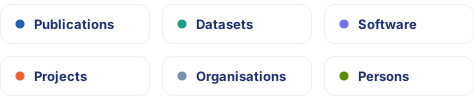
Every entity comes with analytics, complex query building, and API access, not just a results list.
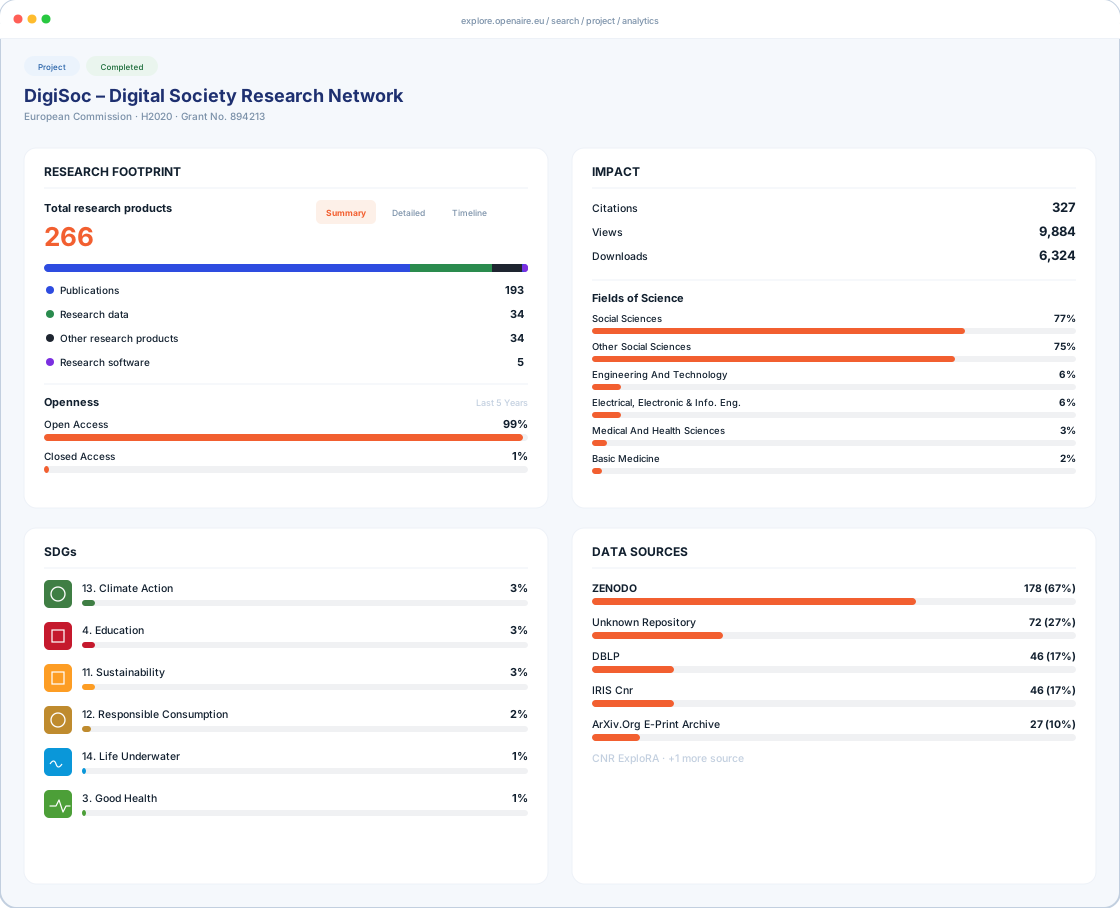
Claim, embed, report
The three things researchers and PIs do most, each covered step by step on the For Researchers page.
Reporting with advanced statistics. Switch any results list to the Analytics view, then filter by funder, organisation or project to get totals, trends over time, open access and content type breakdowns, and top fields of science, ready to drop into a report. For deeper indicators, OpenAIRE Monitor goes further.
Sources and funders
Metadata comes from over 2,100 direct sources, repositories, journals and CRIS systems, rising to 155,000+ once indirect aggregators are counted.
368 funders are already connected, from the European Commission to national research councils, linking every grant to the outputs it produced.
Built to be trusted, not just aggregated
Every record passes through several data quality steps before you see it: merging duplicates, resolving affiliations to real organisations, and mining full text for links that would otherwise stay hidden.
-
Deduplication
A paper held in 50 repositories appears once in Explore. All representations of the same record are merged into a single entry, with every contributing source preserved underneath, so counts reflect real, distinct research outputs. -
Affiliation matching
A raw affiliation string, "Dept. of Physics, MIT, Cambridge MA", and a dozen variants of the same institution, gets matched to a single ROR identifier by AFRO, OpenAIRE's open-source affiliation-matching algorithm. AFRO parses full texts and metadata records, then uses similarity matching against the ROR registry to resolve abbreviated, ambiguous or multilingual institution names to the right organisation. -
Citation & reference mining
Text mining goes beyond affiliations. Full texts are mined for grant acknowledgements, citations to other papers, and links to the datasets and software a paper actually used, connections that often exist nowhere in the original structured metadata. This is how you can navigate from a paper to its underlying data, its funding, and the work that later built on it.
Open Access routes
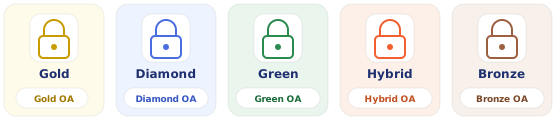
How each color is computed
-
 Gold OAThe publishing journal is matched, by ISSN, against our reconstruction of the ISSN-GOLD-OA list, following Bielefeld University's published methodology . If the journal is on that list, the article is Gold.
-
 Diamond OAThe publishing journal is checked against the DOAJ data dump to confirm it charges no APCs, and against the Diamond Discovery Hub's operational criteria. A match on either makes the article Diamond.
-
 Green OAComputed directly from the article's own deposit record: published in a toll-access journal, but a copy exists in a repository. Whether an open licence is attached to that copy determines Green with or without licence.
-
 Hybrid OAComputed from the article's own licence field: published in a subscription journal, but this particular article carries an explicit CC licence. Only CC counts, so this is a narrower test than Green.
-
 BronzeWhatever is free to read on the publisher's site but fails every test above, no qualifying licence, no repository copy. It is the default when nothing else matches.
Known limitations. Because only CC licences count for Hybrid, Hybrid can be undercounted and Bronze overcounted. Gold is computed from the journal's current ISSN match, so an article published while that journal was still Hybrid can be reclassified as Gold once the journal converts, which can overstate Gold counts.
How we calculate peer-reviewed
A peer-reviewed publication is a scholarly article that has been evaluated and critiqued by independent experts in the same field before publication, the method academic journals widely use to enhance the credibility and reliability of published research.
Publications are marked as peer-reviewed when explicitly identified as peer reviewed by a trusted source or OpenAIRE curation, or, where explicit information is unavailable, scholarly journal articles for which bibliographic evidence supports peer-review status. Publications identified as preprints, grey literature or other non-peer-reviewed types are excluded. Publications for which peer-review status cannot be reliably determined are treated as unknown. Counts refer to deduplicated publications.
Fields of Science and SDGs
Every record is classified by Field of Science, with multidisciplinary work receiving several tags, and mapped to the UN Sustainable Development Goals. Ask not just what was published on climate, but what open research contributed to SDG 13, and cross-reference with any funder, institution or year.
Citation impact indicators
Beyond a raw citation count, every record carries three indicators built from the same underlying citation network, each answering a different question about its impact.
